


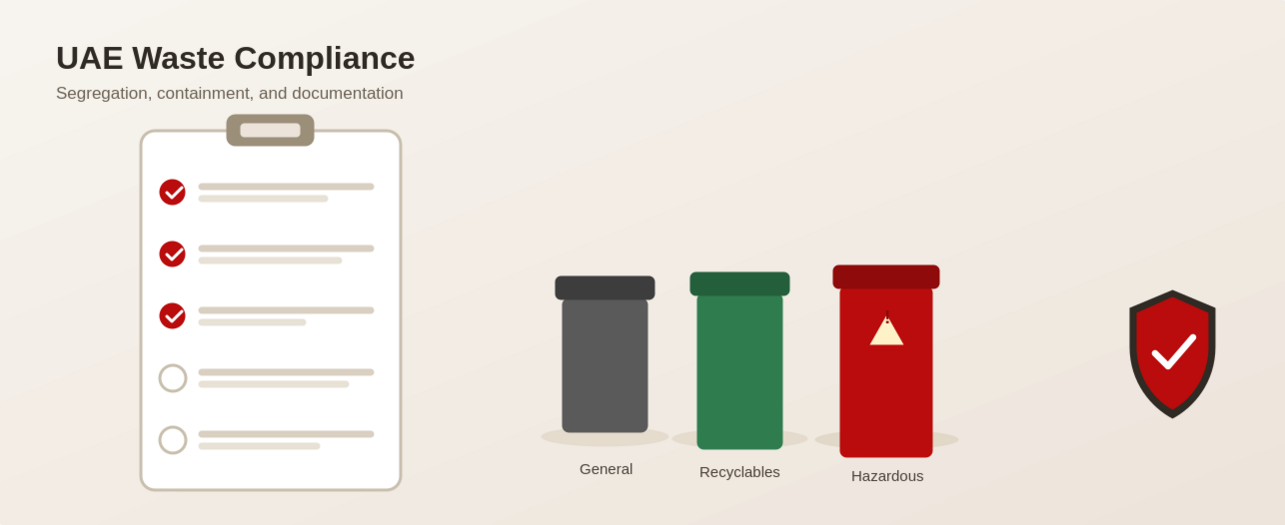
Waste management in the UAE has moved well past “just get a bin and a collection schedule.” Between federal environmental law, emirate-level municipality rules, and free zone-specific requirements, businesses are increasingly expected to show that waste is being segregated, stored, and handled correctly — not just removed from sight.
Here's a practical overview of what commercial and industrial operators should have in place.
The Regulatory Layers You're Actually Working With
Waste compliance in the UAE isn't governed by a single rulebook. Businesses typically need to account for:
● Federal environmental legislation, which sets the baseline for waste classification, hazardous waste handling, and environmental protection obligations nationwide.
● Emirate-level municipality regulations — Dubai Municipality, Abu Dhabi's Tadweer, Sharjah Municipality, and others each set their own requirements for commercial waste storage, collection contracts, and segregation standards within their jurisdiction.
● Free zone authority rules, which can layer additional requirements on top of emirate regulations for businesses operating within zones like JAFZA, DMCC, or industrial free zones.
● Sector-specific requirements, particularly for healthcare, pharmaceuticals, food and beverage, and hospitality, where waste often needs specialized containment, labeling, or disposal pathways.
The practical takeaway: a facilities manager can't assume that what worked for one site or one emirate automatically satisfies requirements elsewhere. It's worth confirming current requirements with your local municipality or environmental authority before finalizing a waste management setup, since rules are updated periodically.
Segregation Is No Longer Optional in Most Jurisdictions
Source segregation — separating recyclables, organic waste, general waste, and hazardous material at the point of generation — has become a standard expectation across UAE municipalities, particularly for larger commercial and industrial operators. This typically means:
● Color-coded or labeled bins for different waste streams, positioned at collection points throughout a facility
● Separate storage for hazardous or medical waste, which generally cannot be co-mingled with general commercial waste under any circumstances
● Documented collection and disposal records, especially for regulated waste categories, which may be requested during inspections or audits
For multi-tenant buildings, malls, and mixed-use developments, this often means coordinating waste infrastructure across multiple tenants who may each be generating different waste types — something that needs to be planned at the design stage rather than retrofitted later.
Hazardous and Medical Waste: A Higher Bar
Facilities generating hazardous or medical waste — hospitals, clinics, pharmaceutical manufacturers, labs, and certain industrial operations — face stricter requirements, including:
● Containment designed specifically to prevent leaks, spills, and unauthorized access
● Clear hazard labeling and often UN-certified container specifications
● Chain-of-custody tracking from generation through final disposal or treatment
● Storage areas that are physically separated from general waste handling zones
Using general-purpose bins for this category of waste isn't just a compliance risk — it's a genuine safety issue for the staff handling collection and transport.
Food and Organic Waste: A Growing Compliance Focus
With sustainability targets tightening across the UAE, food waste diversion is increasingly on regulators' radar for the hospitality, catering, and food retail sectors. Businesses generating significant food waste volumes are being encouraged — and in some cases required — to demonstrate diversion from landfill, whether through on-site digestion, composting, or dedicated organic waste collection streams. Restaurants, hotels, and catering operations that haven't yet addressed this are likely to see it become a bigger factor in licensing and sustainability reporting going forward.
A Practical Compliance Checklist
For businesses reviewing their current setup, a few questions are worth asking:
1. Are waste streams physically segregated at the point of generation, not just at the final collection point?
2. Are hazardous or medical waste containers meeting the specific containment standards required for that waste category?
3. Is there a documented, auditable trail for how regulated waste is collected and disposed of?
4. Does your equipment — bins, skips, compactors — actually match the volume and type of waste you're generating, or has it just been carried over from a previous tenant or contractor?
5. Have you confirmed current requirements with your local municipality or free zone authority in the last 12 months?
Getting the Infrastructure Right
Compliance ultimately comes down to having the right physical infrastructure in place — properly labeled and segregated bins, containment suited to hazardous or medical waste, and equipment sized correctly for your actual waste volumes.
POWER Bear manufactures and supplies commercial waste bins, hazardous and medical waste containers, skips, and compactors across the UAE and MENA region, built to DIN and international standards. If you're reassessing your site's waste setup, our team can help match equipment to your regulatory and operational requirements.
This article provides a general overview and isn't a substitute for legal or regulatory advice. Always confirm current requirements with the relevant municipality, free zone authority, or environmental agency for your spec
